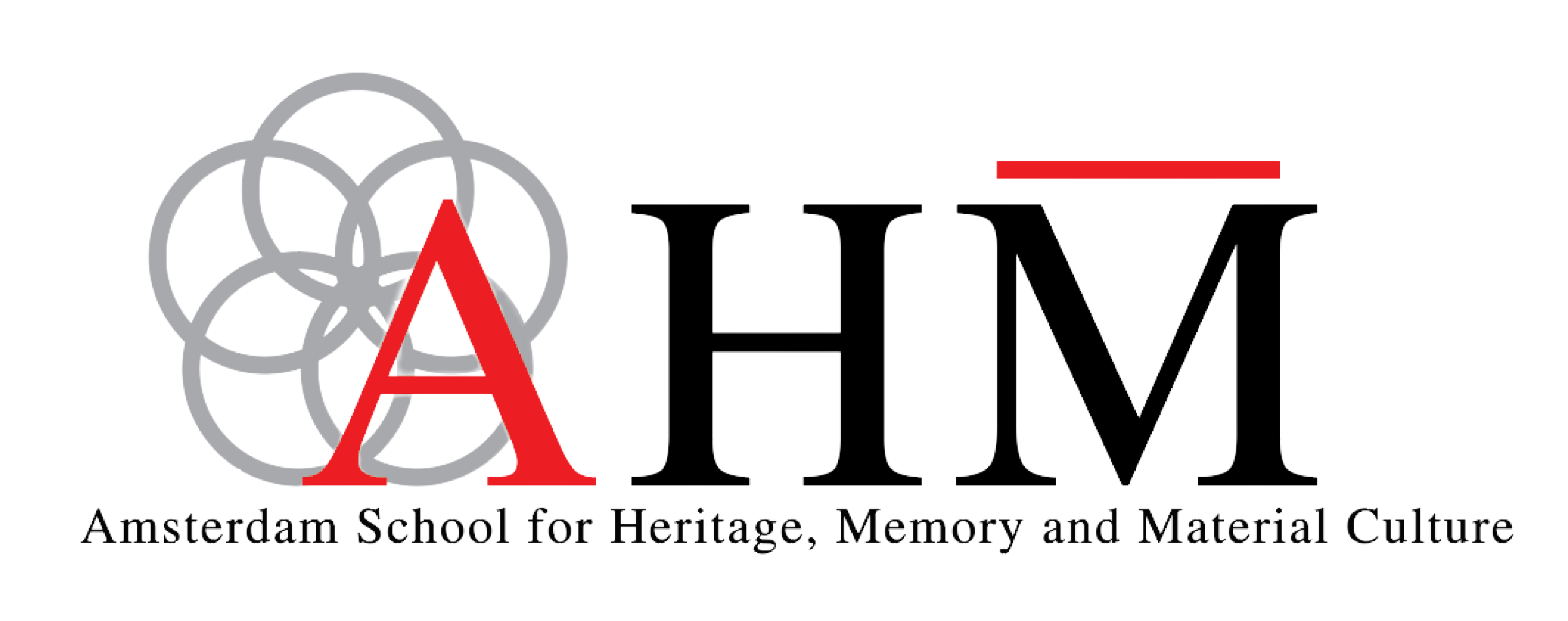
Unsettling Heritage and memory futures
Decolonial Trajectories Between Crisis and Possibility
Amsterdam | June 17-19, 2026
About AHM
Located at the Faculty of Humanities of the University of Amsterdam, the Amsterdam School for Heritage, Memory and Material Culture (AHM) is a research institute and doctoral school committed to the analysis of the remnants and narratives of the past in the present, as well as of the remaking of pasts into heritage, memory and material culture.
AHM seeks to integrate all branches of research focusing on the material and intangible remains of the past, the reciprocal relations between objects and meanings, and the dynamics of memory, from diverse theoretical and methodological perspectives, concept-oriented, object-oriented and user-oriented approaches. The integrative, interdisciplinary and critical approach of problematising, conceptualising and analysing heritage and memory acts, and material culture practices, policies and politics on all levels in Europe and beyond is unique to AHM.
For more information, see the website.
organising committee
The organising committee of the AHM Annual Conference 2026 is composed of academic staff active in the research school.
Conference assistants
- Ms. Brechtje Inklaar
- Ms. Emilia Bebic
- Ms. Aine Ray
scientific committee
- Prof. Nanci Adler (Holocaust & Genocide Studies, NIOD)
- Prof. Maarten van Bommel (Conservation & Restoration)
- Prof. James Symonds (Archaeology)
- Dr. Nour Munawar (Heritage and conflict)
- Dr. Hayley Mickleburgh (4D Lab)
- Dr. Christian Olesen (Digital Heritage)
- Dr. David Duindam (Literary Studies)
- Prof. Ihab Saloul (Heritage and Memory Studies)

applications
Decoloniality is not merely an academic lens but a profound reorientation of knowledge and power. While rooted in twentieth-century South American scholarship, decoloniality now inspires a generation of scholarship and social movements. After years of vibrant scholarship and activism, we stand at a pivotal juncture. The Amsterdam School for Heritage, Memory and Material Culture (AHM) invites scholars, practitioners, artists, and activists to reflect on what decolonial approaches have disrupted, dismantled, and dreamt anew—and to critically assess their strengths, limitations, and futures. As resurgent nationalisms and neocolonial forces challenge gains made in diversifying heritage institutions, democratising memory practices, and centring marginalised voices, how do we sustain decolonial futures that remain precarious? This international conference examines decoloniality as a transformative praxis that reshapes our engagement with heritage, memory, and material culture. We seek contributions that bridge theory and practice, addressing both the generative possibilities and the ethical impasses emerging from decolonial work.
This interdisciplinary gathering will foster dialogue through individual papers, themed panels, and roundtable discussions across diverse geographical contexts. The Organising Committee invites submissions from established scholars, early-career researchers, PhD candidates, professionals, civil society organisations, artists, and activists. We especially welcome voices from the Global South and underrepresented regions, aiming to move beyond critique toward concrete strategies for sustaining decolonial transformation worldwide.
Themes of this conference include, but are not limited to:
- Socio-Political Dimensions of Decoloniality
- Heritage Management and Sustainability
- Post-Conflict Reconstruction and Societal Recovery
- Museum and Memorial Practices
- Restitution and Repatriation
- Community Engagement with Tangible and Intangible Heritage
- Contested Memories and Competing Narratives
- Peace and Conflict Studies
- AI and Digital Heritage Tools
- Materiality and Material Culture
- The Politics of Terminology, Time, and Identity
The conference will be held in-person at the University of Amsterdam (UvA), University Theatre, between 17-19 June, 2026.
Applications should include
– Author name(s) and affiliation(s)
– Email address
– Paper, panel, or roundtable title
– Abstract (250 words)
For panel and roundtable proposals, please include the names, affiliations, and abstracts of each participant.
Please submit your abstract (in English) as a Word document or PDF via email to our conference email: ahmannualconference@gmail.com
Proposals can be submitted by 27 March 2026 (mid-night Central European Time) to ahmannualconference@gmail.com
The notification of acceptance will be sent by mid-April 2026. The Organising Committee will invite some of the accepted papers to submit full papers (6000-7000 words) to be published as part of a special issue at the international peer-reviewed journal of Heritage, Memory and Conflict (Amsterdam University Press). The deadline for the full paper will be communicated later.
See a downloadable version of the Call for Papers here.
keynotes
1. Decoloniality in Palestine: Law, and Narrative Sovereignty
The keynote panel promises to be not just an analysis of a situation, but an active engagement in the intellectual and practical work of decolonisation. This keynote panel convenes at a critical juncture in international discourse on Palestine, framed explicitly through the lens of decolonial theory and practice. Moving beyond conventional geopolitical analysis, the panel will dissect the multifaceted structures of occupation, erasure, and resistance by examining two interconnected pillars: International Law as a Site of Struggle, and the Decolonisation of Interfaith and Cultural Narratives. The discussion will explore wider implications for European policy, legal accountability, and the ideological underpinnings of settler colonialism. The panel aims to create a rigorous, interdisciplinary academic dialogue that bridges the immediacy of political developments with deeper, systemic critiques of power, representation, and justice.
Speakers:
Prof. Alette Smeulers
Alette Smeulers Is A Full Professor Of International Crimes At The University Of Groningen And One Of The Founders Of Supranational Criminology, The Criminology Of International Crimes Which Brings Together Scholars From Various Disciplinary Fields Who Study Mass Atrocities. In Her Own Research She Takes An Inter- And Multidisciplinary Approach And Focuses On International Crimes (Genocide, Crimes Against Humanity And War Crimes) As Well As Terrorism: The Causes Thereof, The Perpetrators And The International Criminal Justice System. She Wrote Perpetrators Of Mass Atrocities: Terribly And Terrifyingly Normal? (Routledge 2024) Which Was Translated Into Dutch With The Title: Angstaanjagend Normaal (Alfabet 2025). She Is A Passionate Scholar, Teacher, Public Speaker And Has Published Widely In The Field. Together With Nicola Quaedvlieg She Also Has A Podcast Series Also Called: Terribly And Terrifyingly Normal, See Https://Open.spotify.com/Show/2Bt5Wg5nbekeSo8UBDI5MY. For More Information, See Her Website: Https://Alettesmeulers.org/En/Home/
Rev. Prof. Dr. Mitri Raheb
Founder and President of Dar al-Kalima University in Bethlehem. The most widely published Palestinian theologian to date, Dr. Raheb is the author and editor of 54 books including: Decolonizing Palestine: The Land, The People, The Bible; Politics of Persecution: Middle Eastern Christians in an Age of Empire; Faith in the Face of Empire: The Bible through Palestinian Eyes; His books and numerous articles have been translated so far into fifteen languages. Dr. Raheb is a founding and board member of the National Library of Palestine. Rev. Dr Raheb received two honorary doctorates and several international awards including the German Media Prize was awarded to Dr. Raheb. The work of Dr. Raheb has received wide media attention from major international media outlets and networks. Dr. Raheb holds a Doctorate in Theology from the Philipps University at Marburg, Germany. www.mitriraheb.org
Dr. Marieke de Hoon
Dr. Marieke de hoon is Associate Professor of international criminal law at the University of Amsterdam and Director of the Amsterdam Center for Criminal Justice. Her research examines the law and politics of legal interventions in conflict, to understand how law is shaped in geopolitical contexts and how politics is shaped through the use of the language of law and its institutions. De Hoon currently has a research grant to build a research group studying the digitalization and transnationalization of the atrocity crimes investigations landscape, and how that impacts the role of the domestic prosecutor of international crimes. She has regularly testified in Dutch parliament on the application of and obligations under the Genocide Convention and international criminal law for states and their political actors, including related to Israel/Palestine.
2. Decoloniality and Community: Critical Perspectives from Latin America and the Caribbean
This keynote panel assembles critical perspectives on community and decoloniality in heritage practices of archaeology, museology, and policymaking across Latin America and the Caribbean. The panel will consider “community” as an object that is, on the one hand, constructed by institutional logics as the face of recent decolonial approaches, and on the other, a real, material, and complex form of local social life that exists in historical and contemporary matrices of power, both from within and without. Panelists will engage with the affordances and pitfalls of the community concept for decolonial heritage work across three domains: archaeological discourse and practice, the museum, and policy and ethics. Attending to materiality, material inequality, histories and legacies of colonialism, and the real-world complexity of institutional arrangements, this panel aims to balance rigorous critique with practical case studies and offer flexible templates for the future.
Speakers:
Dr. Claudia Uribe Chinen
Dr. Claudia Uribe Chinen is an archaeologist specializing in public archaeology, heritage studies and the archaeology of earthen technologies. She holds a Ph.D. in Heritage Studies from the University of Tsukuba, Japan. Her research critically examines heritage policies and governance frameworks, archaeological ethics, and the production of Pre-Hispanic earthen technologies in the central coast of Peru. She currently serves as an Adjunct Professor in the Department of Humanities at PUCP, Curator of the Josefina Ramos de Cox Museum of Archaeology (IRA-PUCP), and Associate Researcher at the Riva-Agüero Institute.
Dr. Bruno Brulon Soares
Bruno Brulon Soares is a museologist and anthropologist trained in Brazil whose research interests have focused on the relationships of museums with society, practices of collecting, and the political uses of heritage. He has a Ph.D. in Anthropology (2012) and another in Contemporary History (2019) both from Universidade Federal Fluminense, and an MA in Museology and Heritage Studies (2008) from Universidade Federal do Estado do Rio de Janeiro. Soares is currently a Reader in Museum and Heritage Studies in the School of Art History. Prior to joining St Andrews, he was Professor of Museology and Heritage Studies at Universidade Federal do Estado do Rio de Janeiro (2013-2022) and Chair of the International Committee for Museology of ICOM, the International Council of Museums (2019-2022).